

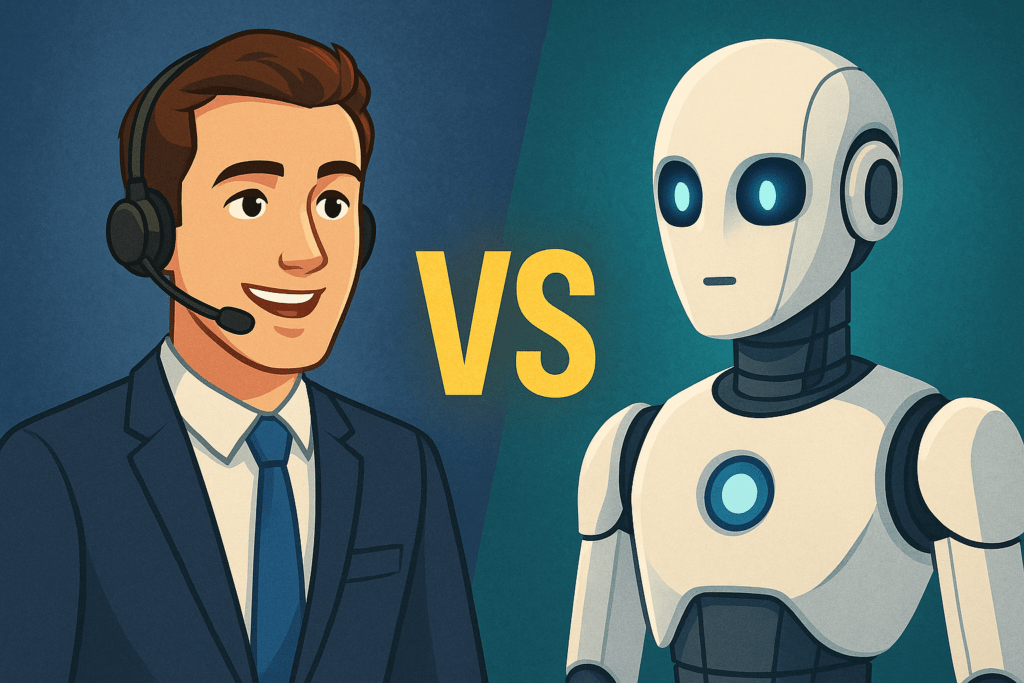
Key Takeaways
If you’ve called a support line recently, you’ve probably been greeted by a chatbot. Maybe it helped. More likely, you spent five minutes typing “speak to a human” in increasingly creative ways.
You’re not alone. The push to automate customer service has been one of the biggest business trends of the past few years, and on paper, it makes sense. AI is faster, cheaper, available 24/7, and never calls in sick. But there’s a growing gap between what businesses think customers want and what customers actually want.
The data is clear: most people still prefer talking to a real person. And for small and mid-sized businesses trying to deliver great service without enterprise budgets, that’s actually good news — because human support doesn’t have to be expensive.
- 93.4% of consumers prefer human customer service over AI chatbots
- A trained Filipino VA costs $800 – $1,200/mo — roughly the same as a mid-tier chatbot
- 75% of customers want AI for simple tasks with easy escalation to a real person
- The hybrid model (AI + VA) delivers the best results at the lowest cost for SMBs
Let’s look at what the numbers say, what they mean, and how to build a support model that actually works.
The Data: Customers Overwhelmingly Prefer Humans
This isn’t guesswork. Multiple large-scale studies from 2024 and 2025 all point in the same direction.
That’s from a 2025 Kinsta study surveying 1,011 US consumers. Not a slim majority — an overwhelming one. When given the choice between a chatbot and a person, nearly everyone picks the person.
CallVU’s 2024 research found that customers would rather sit on hold than interact with automation. People actively choose to wait — something we all hate — just to avoid talking to a bot.
Salesforce surveyed 15,000 consumers globally in 2024 and found that nearly two-thirds want a real person guiding them through purchases. When money is on the line, trust matters more than speed.
A 2025 Baringa study of over 5,000 consumers found that most people feel uneasy when they suspect they’re reading or interacting with something produced by AI. Authenticity isn’t just a buzzword — it’s a buying factor.
And when it comes to actually solving problems? 78% of customers say humans resolve issues faster, and 84% say humans resolve them more accurately. The very things AI is supposed to be better at — speed and precision — customers don’t experience that way in practice.
Even Gen Z Prefers Humans (Just Not as Much as Their Parents)
There’s a common assumption that younger consumers are fine with AI everything. The data tells a more nuanced story.
| Generation | Prefer Human Support | Accept AI |
|---|---|---|
| Baby Boomers | 86% | 14% |
| Gen X | 79% | 21% |
| Millennials | 73% | 27% |
| Gen Z | 66% | 34% |
Gen Z is more comfortable with technology, sure. But “comfortable with technology” doesn’t mean “wants to troubleshoot a billing issue with a chatbot.” Even the most digitally native generation overwhelmingly wants a human when something goes wrong.
Why Customers Prefer Humans: It’s Not Just Nostalgia
When you dig into the reasons behind these numbers, the preference for human support isn’t about being old-fashioned or resistant to change. It’s practical.
Empathy Can’t Be Scripted
When a customer is frustrated — maybe they received the wrong product, or they’ve been charged twice, or they’re dealing with a time-sensitive issue — they want to feel heard. A human agent can pick up on tone, adjust their approach, and say “I understand how frustrating this must be” in a way that actually lands. AI can generate those words, but customers can tell the difference.
Complex Problems Need Flexible Thinking
AI chatbots work from decision trees and pattern matching. They’re excellent when the problem fits neatly into a predefined category. But real customer issues are messy. They involve context, exceptions, and situations the system wasn’t designed for. A human can think laterally, make judgment calls, and find creative solutions that no flowchart anticipated.
Trust Is Built Through Connection
Especially in sales and high-stakes support interactions, customers are making a decision about whether to trust your business. That trust is built through conversation — through a person who listens, asks the right questions, and demonstrates genuine understanding. You don’t build brand loyalty with a chatbot. You build it with people.
Nuance Gets Lost in Automation
Sarcasm, urgency, cultural context, implied meaning — human communication is layered. A customer who writes “Great, so my order is lost. Wonderful.” isn’t expressing satisfaction. A well-trained human agent reads that instantly. AI? It might respond with “We’re glad you think so!”
Where AI Actually Works Well
None of this means AI has no place in customer service. It absolutely does — just not the place most businesses are putting it.
AI excels at the tasks that don’t require human judgment:
- Simple FAQs: “What are your business hours?” “Where’s my tracking number?” “What’s your return policy?” Perfect for automation — quick, factual, no emotion involved.
- Intelligent routing: AI can analyze an incoming query and route it to the right department or agent instantly, cutting wait times without removing the human.
- 24/7 availability for basic needs: Not every query needs a human at 3 AM. AI can handle password resets, order status checks, and appointment confirmations around the clock.
- Data lookup and pre-qualification: Before a customer even reaches an agent, AI can pull up their account, order history, and previous interactions — so the human agent has full context from the first second.
AI handles volume. Humans handle value.
Let automation take care of the repetitive, low-stakes interactions so your human agents can focus on the conversations that actually matter. And that’s exactly what 75% of consumers say they want — AI for simple tasks, with a clear and easy path to escalate to a real person when needed.
The Hybrid Model: AI as the Filter, Humans as the Foundation
The best customer service teams in 2026 aren’t choosing between AI and humans. They’re using both strategically.
A chatbot greets the customer, handles simple requests instantly, and identifies complex issues that need human attention.
When the AI detects frustration, complexity, or a high-value customer, it routes the conversation to a human agent with full context attached.
A trained agent picks up the conversation already knowing who the customer is, what they need, and what’s already been tried. No “can you repeat your issue?” No starting from scratch.
This model gives you the efficiency of AI and the effectiveness of human support. Customers get fast answers for simple things and real help for everything else.
And this is exactly where virtual assistants shine. A trained VA can be that human layer — handling escalated chats, managing email support, following up on tickets, and building real relationships with your customers.
The Cost Comparison Most Businesses Get Wrong
One of the biggest arguments for AI-only customer service is cost. But the numbers don’t support the assumption that bots are dramatically cheaper than humans — at least not when you compare the right options.
| Option | Monthly Cost | Coverage | Best For |
|---|---|---|---|
| AI Chatbot Only | $500 – $2,000 | 24/7 automated | FAQs, simple queries |
| Dedicated Filipino VA | $800 – $1,200 | 8 hrs/day, 5 days/week | Complex issues, sales, retention |
| Hybrid (AI + VA) | $1,300 – $2,200 | 24/7 with human backup | Best of both worlds |
A basic chatbot with canned responses is cheap. But a good AI customer service platform — one that handles conversations well, integrates with your systems, and doesn’t make your brand look amateurish — runs $500 to $2,000 per month. That’s before setup, training the AI, ongoing maintenance, and lost customers when the bot fails.
A full-time, trained Filipino VA specializing in customer service costs $800 to $1,200 per month. That’s a dedicated human being working 8 hours a day who can handle emails, live chat, phone support, and social media inquiries. They learn your business, remember repeat customers, and get better over time.
For most SMBs, the hybrid approach — a basic automation tool paired with a trained VA — delivers better satisfaction at comparable or lower cost than a premium AI-only solution.
What This Means for Small and Mid-Sized Businesses
If you’re running an SMB, you don’t need to invest in enterprise AI to deliver great customer service. In fact, doing so might actively hurt your customer experience.
Here’s the reality: your customers don’t care about your tech stack. They care about getting their problem solved quickly, by someone who actually understands what they’re saying. A well-trained virtual assistant does exactly that.
The businesses that are winning at customer service right now aren’t the ones with the fanciest AI. They’re the ones that figured out the right balance — automation for efficiency, humans for effectiveness.
And for SMBs specifically, Filipino VAs represent a unique opportunity. The Philippines has one of the highest English proficiency rates in Asia, a strong service-oriented culture, and a workforce deeply experienced in remote customer support. You’re not getting a discount option — you’re getting a genuinely skilled professional at a price point that makes the human vs. AI debate almost irrelevant.
How to Set Up a Hybrid Support Model With VAs
Ready to build a customer service system that actually works? Here’s a practical roadmap:
Look at your last 30 days of customer inquiries. Categorize them: How many are simple, repetitive questions? How many require real problem-solving? How many involve sales or retention? This tells you where AI fits and where you need humans.
You don’t need an expensive AI platform. A simple chatbot, a well-organized FAQ page, or automated email responses can handle the basics. Tools like Tidio, Crisp, or WhatsApp Business auto-reply can filter out simple queries.
This is your human layer. Look for someone with customer service experience, strong English skills, and the ability to learn your product quickly. At Armasourcing, we match businesses with Filipino VAs specifically trained for customer-facing roles.
Define exactly when a conversation moves from AI to human. Set triggers based on keywords (“cancel,” “refund,” “speak to someone”), customer sentiment, or issue complexity. Make the handoff seamless.
Give your VA access to your CRM, order management system, and internal knowledge bases. Tools like Zendesk, Freshdesk, or even a shared Google Doc can work depending on your scale.
Monitor response times, resolution rates, and satisfaction scores. Have regular check-ins with your VA. Review common issues and update your FAQ and automation rules. A good hybrid system gets better every month.
The Bottom Line
The data doesn’t lie. Customers want humans. They’ll wait for humans. They trust humans more. They believe humans solve their problems faster and more accurately. And this is true across every age group, in every major study from the past two years.
That doesn’t mean AI is useless — far from it. But it means that businesses replacing their entire customer service function with chatbots are making an expensive mistake.
The future of customer service isn’t AI or humans. It’s AI and humans, working together.
And if you’re looking for the human side of that equation — skilled, English-fluent, customer-service-trained professionals who cost less than a premium chatbot subscription — that’s exactly what we do at Armasourcing.
Talk to us about building your hybrid support team. We’ll help you find a VA who fits your business, your customers, and your budget.
Need Help Scaling Your Business?
Get matched with a pre-vetted Filipino virtual assistant in under 7 days. Book a free discovery call.