
If you have ever thought, “I already explained this,” you are not alone.
Most founders and operators do not have an “operations problem.” They have a “knowledge trapped in people’s heads” problem. The business runs because you remember the steps, catch mistakes, and answer questions in real time. That works until you hire help, outsource, or try to scale. Then everything that used to feel manageable turns into back and forth, missed details, and inconsistent output.
That is exactly why SOPs matter.
At Armasourcing, we see the same pattern across growing teams: the fastest way to get reliable results from a VA or remote team is not hiring “perfect” people. It is giving good people a clear, repeatable process they can follow.
In this guide, you will get a copy-paste SOP template plus a simple method to write SOPs quickly, even if you have never documented a process before.
What Is An SOP
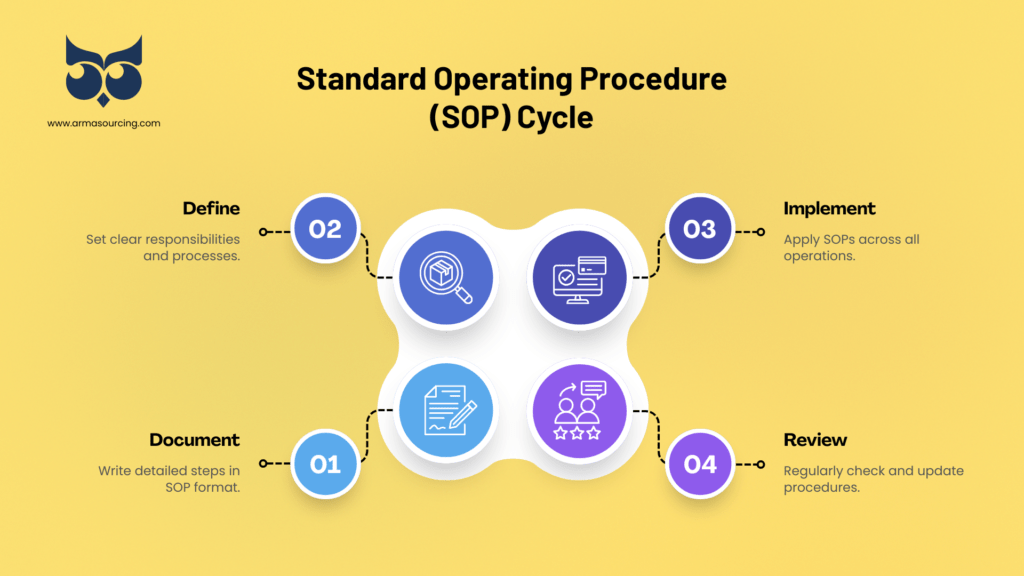
An SOP (Standard Operating Procedure) is a written step-by-step process that makes a task repeatable, trainable, and quality-controlled.
A strong SOP does three things:
Makes results consistent (even when different people do the work)
Reduces questions and rework (because expectations are explicit)
Speeds up onboarding (because training becomes “follow the system,” not “shadow the founder”)
If you can explain a task once, you can SOP it and delegate it again and again.
SOP Template (Copy-Paste)
You can paste this into Google Docs, Notion, ClickUp, or any tool your team uses. If you want the SOP to actually get used, keep it practical and easy to scan.
SOP Template
- SOP Name
- Type here…
- Department/Function
- Admin, Sales, Support, Ops, Marketing, Finance
- Owner
- Type here…
- Last Updated
- YYYY-MM-DD
- Purpose
- Why this SOP exists (1–2 sentences)…
- When To Use This SOP (Trigger)
- Example: When a new lead fills out the contact form.
- Tools / Access Needed
- List tools, logins, permissions, links, folders, templates…
- Inputs Required (Before You Start)
- What must be provided or confirmed before the task begins…
- Definition Of Done (How You Know It’s Complete)
- Clear completion rules. Example: Client updated in CRM, tag applied, follow-up scheduled, confirmation email sent.
- Step-by-Step Instructions
-
- Step 1…
- Step 2…
- Step 3…
Tip: One action per line. Avoid long paragraphs.
- Quality Checks (Before Marking Complete)
- What to verify. Example: Spelling checked, correct template used, correct tags applied, links work.
- Edge Cases (If Something Goes Wrong)
- If X happens, do Y.
- Escalation Rules (When To Ask For Help)
- Example: If customer requests refund over $200, escalate to manager.
- Time Expectation
- Typical time range for the task…
- Example / References (Optional)
- Screenshots, sample output, Loom link, or a completed example…
How To Write An SOP Fast (7 Steps)
You do not need a week of planning. You need a fast draft and one real test.
1) Pick A Task You Repeat Weekly
Start with high-frequency tasks that cause friction, like:
Inbox triage
Booking calls
Posting content
Sending invoices
Following up on vendors
Updating trackers
2) Write The Trigger And Definition Of Done
These two lines alone prevent confusion.
Trigger: “When does this start?”
Definition of Done: “What is the finished output?”
Most SOPs fail because they never define what “done” looks like.
3) List Tools And Access
Write down what your team actually needs:
Where the files live
Which spreadsheet tab to use
Which email template to send
Which permissions are required
If access is unclear, the SOP will stall.
4) Draft Steps As Verbs
Write steps like actions:
Open
Check
Update
Copy
Paste
Send
Tag
Assign
Schedule
Avoid paragraphs. If a step needs explanation, add a short note under that step.
5) Add Quality Checks
Quality checks are the “guardrails” that protect output.
Examples:
Confirm correct client name and email
Confirm correct tags applied in CRM
Confirm links are working
Confirm file naming is correct
Confirm date ranges are correct
6) Add Edge Cases And Escalation Rules
This is how you stop Slack messages every 10 minutes.
Examples:
“If the customer is angry, use template B and escalate if they request a manager.”
“If the vendor does not respond in 48 hours, follow up again and CC ops.”
“If the job is outside service area, send the out-of-area message and tag as ‘Not a Fit.’”
7) Test With Fresh Eyes
The best test is giving it to someone who did not create it (your VA, ops assistant, or team member).
If they get stuck, your SOP is missing a tool, an input, or a decision rule.
SOP Examples You Can Build This Week
If you are not sure what to document first, here are SOP titles that create quick wins in most businesses.
Admin
Daily Inbox Triage And Follow-Up Rules
Calendar Management And Meeting Prep Checklist
File Naming, Folder Structure, And Where Everything Lives
Sales
Lead Intake And Qualification Workflow
Booking Calls And No-Show Follow-Up Process
Proposal Sending And Next-Step Tracking
Customer Support
Refund Request Handling And Approval Rules
Ticket Triage And Escalation Rules
Response Templates And Tone Guidelines
Operations
Weekly Vendor Follow-Up And Purchase Tracking
Order Exception Handling (Late Shipment, Wrong Item, Damaged Goods)
Project Handoff From Sales To Delivery
Marketing
Publish A Blog Post From Draft To Live
Repurpose One Video Into 5 Social Posts
Weekly Content Calendar Planning Workflow
Finance
Invoice Creation And Payment Confirmation Process
Monthly Expense Categorization And Reporting
Collections Follow-Up Process
If you build SOPs for the top 3 tasks that repeat every week, you will feel the impact immediately.
The Most Common SOP Mistakes (And How To Fix Them)
Mistake 1: Writing A “Guide” Instead Of A Process
A guide is educational. An SOP is operational.
Fix: Use step-by-step actions and define the output clearly.
Mistake 2: No Definition Of Done
If “done” is vague, quality will drift.
Fix: Add measurable completion rules like “CRM updated, tag applied, email sent, task marked complete.”
Mistake 3: Missing Edge Cases
When edge cases are not documented, your team must ask you.
Fix: Add 5–10 common “if this happens” rules.
Mistake 4: SOPs That Never Get Updated
SOPs should improve with use.
Fix: Assign an owner and add a “Last Updated” date. Anytime the SOP changes, update the doc immediately.
SOPs For Virtual Assistants (The Armasourcing Perspective)
If you plan to hire or already hired a VA, SOPs are the difference between “helpful support” and “true leverage.”
A VA can move fast when three things are clear:
What starts the task (trigger)
What finished looks like (definition of done)
When to decide vs when to escalate (edge cases and rules)
Without SOPs, the VA may still be great, but progress slows because everything becomes a conversation. With SOPs, work becomes a system.
A simple way to think about it:
Hiring is the “who”
SOPs are the “how”
Quality checks are the “standard”
Escalation rules are the “safety net”
If you want to delegate confidently, SOPs are your best friend.
A Simple SOP Rollout Plan (So It Actually Gets Used)
If you try to document everything, you will burn out. If you document the right things first, SOPs become addictive because you feel the relief.
Week 1: SOP Your Top 3 Repeating Tasks
Choose tasks you do constantly. Do not overthink it. Draft fast.
Week 2: Add Quality Checks And Edge Cases
This is where SOPs start reducing questions.
Week 3: Assign Owners And Create A Single SOP Index
Make one “SOP Index” doc that links to every SOP. Keep it simple:
SOP name
department
owner
link
last updated
Week 4: Turn SOPs Into Training
Once SOPs exist, onboarding becomes:
Read SOP
Watch example (optional)
Do the task
Submit for review
Improve SOP based on feedback
This is how you build a process library that scales.
