Contents
Call center outsourcing pricing is one of the first questions every operations leader asks, and one of the hardest to get a straight answer to. Quotes vary wildly because the word “outsourcing” covers everything from a shared agent answering calls for ten companies at once to a dedicated, managed team that works only your account. This guide breaks down the real cost of outsourcing your call center in 2026: the pricing models, the per-agent numbers by region, the variables that move your quote, the hidden costs most buyers miss, and how to calculate the true return.
If what you are pricing is a customer service queue rather than a full call center operation, our outsourced customer service cost guide covers those numbers separately.
The three common pricing models
Almost every provider prices one of three ways. Understanding them is the difference between a predictable budget and a surprise invoice.
1. Per seat (per agent, per month)
A flat monthly rate for each dedicated agent. This is the model we use at Armasourcing because it is predictable and easy to budget: you know exactly what a 10-seat or 25-seat team costs each month, and the rate folds in recruiting, training, a Team Lead, QA, and equipment. It suits any business with steady, ongoing volume.
2. Per hour
You pay for agent hours worked. This is flexible for genuinely variable volume, but it is harder to forecast and usually more expensive at steady volume because the provider builds a margin into every hour. It can also incentivise the wrong behaviour if agents are not also held to quality targets.
3. Per minute or per call
Common with shared, non-dedicated call centers. It looks cheapest on paper, but you share agents with other clients, they do not know your product deeply, and quality and brand consistency suffer. It can work for simple, low-stakes overflow, but rarely for support that affects retention.
What a call center agent actually costs by region
The headline number varies enormously by location. These are typical fully-loaded monthly ranges per agent in 2026:
| Location | Fully-loaded cost per agent / month | Best for |
|---|---|---|
| United States (in-house) | $3,500 to $5,500 | Brand-critical, low-volume support |
| United States (onshore BPO) | $2,800 to $4,500 | Domestic-accent requirements |
| Nearshore (Latin America) | $1,800 to $3,000 | Time-zone overlap, bilingual EN/ES |
| Offshore (Philippines, managed) | $1,000 to $1,800 | English voice at scale, 24/7 cost |
| Offshore (India) | $900 to $1,600 | Technical and back-office work |
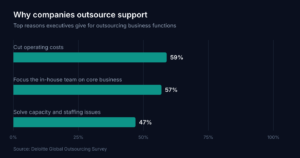
The Philippines consistently lands 60 to 70 percent below onshore for comparable, English-fluent voice support, which is why it remains the worlds leading destination for call center outsourcing in the Philippines. Deloitte’s research on why companies outsource has long pointed to cost reduction as the leading driver, alongside scale and access to talent (Deloitte Global Outsourcing Survey).
What drives your price up or down
- Team size. Larger teams unlock better per-seat economics. A 10-seat desk carries proportionally more overhead than a 50-seat operation.
- Channels. Blended inbound and outbound voice, live chat, and email and ticketing each add scope and may need different skill profiles. Outbound sales programs are telemarketing in the classic sense and are usually scoped separately from support seats.
- Hours of coverage. Single-shift is cheapest; 24/7 coverage costs more in absolute terms but is dramatically cheaper offshore than onshore overtime or night-shift differentials.
- Complexity and compliance. Regulated work (HIPAA, PCI-DSS, TCPA-aware) and Tier-2 technical support carry a premium over basic Tier-1 service.
- Language and specialisation. Bilingual agents, licensed roles, or deep product expertise raise the rate.
- Managed vs staffing. A managed team includes a Team Lead, QA, recruiting, training, and equipment in the per-seat rate. Pure staffing looks cheaper but pushes those costs back onto you.
The hidden costs of an in-house desk
When buyers compare an offshore quote to an in-house salary, they usually compare the wrong numbers. The base salary is only a fraction of the true cost. A realistic in-house build also carries:
- Recruiting and onboarding: job ads, recruiter time, and 4 to 8 weeks of ramp before an agent is productive.
- Benefits and payroll taxes: typically 25 to 40 percent on top of base salary.
- Software and equipment: CRM and helpdesk licences, telephony, workstations, headsets.
- Management overhead: supervisors, QA analysts, and workforce-management time.
- Attrition: contact center turnover is notoriously high, and every departure restarts the recruiting and ramp clock.
Add it up and a fully-loaded US agent often exceeds $4,500 per month. A managed offshore team folds nearly all of that into one predictable per-seat rate. For the full side-by-side, see our guide to in-house vs outsourced contact centers.
How to calculate your true ROI, not just the rate
The cheapest per-seat rate is not always the best value. Model these alongside cost:
- Revenue protected: faster speed-to-answer and lower abandonment recover sales that an understaffed line loses.
- Revenue generated: outbound follow-up, renewals, and appointment setting that an unmanaged team simply never gets to.
- Time reclaimed: senior staff freed from Tier-1 work to do higher-value jobs.
- Quality: first-call resolution and CSAT, which drive retention. A slightly higher rate that lifts FCR usually wins on total economics.
So what should you budget?
As a rule of thumb for a managed Filipino team, plan around three tiers: a 10-seat Starter desk for launching or replacing an overloaded in-house line, a 25-seat Growth desk for steady multi-channel volume, and a 50-plus-seat Scale operation for enterprise volume and 24/7 coverage. Per-seat pricing improves as you move up the tiers. The contact center hub has a live cost estimator that gives you a ballpark monthly figure in about ten seconds.
Sample monthly cost scenarios
Numbers are easier to grasp with worked examples. These illustrate how a managed Filipino contact center typically scales (your exact quote depends on channels, hours, and complexity):
- 10-seat e-commerce inbound desk. A growing online store covering order, returns, and WISMO support during extended business hours. A managed offshore team here costs a fraction of the two or three onshore reps it would replace, and absorbs seasonal spikes without new hiring.
- 25-seat blended desk. A subscription business running inbound support plus outbound renewals and live chat. The blended model keeps agents productive across channels and improves per-seat economics versus single-function teams.
- 50-plus-seat 24/7 operation. A SaaS or healthcare platform needing round-the-clock coverage. Offshore is where 24/7 becomes genuinely affordable, since night-shift work that triggers expensive differentials onshore is standard daytime work in the Philippines.
In each case the per-seat rate falls as the team grows, because fixed overhead (a Team Lead, QA, workforce management) spreads across more agents.
What is included in a per-seat rate (and what is not)
When you compare quotes, confirm what the rate actually covers. A genuine managed rate should include recruiting, training, a dedicated Team Lead, daily QA, equipment, and reporting. Watch for quotes that look cheap because they exclude QA and management, charge separately for reporting, or quietly use shared agents. The lowest sticker price is rarely the lowest total cost once quality and turnover are factored in. Use our provider checklist to compare like for like.
How to reduce your contact center cost without cutting quality
Cheaper does not have to mean worse. The levers that lower cost while protecting (or improving) experience are well established:
- Right-size to real volume. Staff to your actual call and ticket patterns using historical data, not to peak-fear. A managed partner with workforce management does this continuously, so you are not paying for idle seats.
- Blend channels. A single team that handles voice, chat, and email stays productive across quiet and busy moments, raising utilisation without overwork.
- Deflect the deflectable. A good help centre, macros, and self-service reduce low-value contacts so your paid agents focus on interactions that need a human.
- Move volume offshore, keep judgement onshore. Route high-volume Tier-1 to a cost-effective Philippines team and keep complex or brand-critical escalations close.
- Pay for resolution, not activity. Optimising first-call resolution lowers repeat contacts, which is the cheapest volume reduction there is.
Used together, these can cut total cost by a wide margin while raising CSAT, because faster resolution and lower abandonment make customers happier and reduce repeat work.
Next step
Pricing is always custom-quoted to your channels, volume, hours, and complexity, with no placement fees. Explore managed contact center outsourcing, read how to choose a provider, or book a call for a tailored quote.
Frequently asked questions
Is per-seat or per-hour pricing better?
Per-seat is more predictable and usually cheaper at steady volume because you are not paying a margin on every hour. Per-hour suits highly variable, short-term, or seasonal needs where you cannot commit to a fixed headcount.
Why is the Philippines so much cheaper than onshore?
A lower cost of living, a mature outsourcing infrastructure built over two decades, and a large English-fluent workforce let providers deliver comparable quality at 60 to 70 percent less than onshore. See our Philippines guide.
Are there setup or placement fees?
With Armasourcing there are no placement fees. You pay a per-seat monthly rate for a fully managed team, with recruiting, training, QA, and equipment included.
How quickly can a team be running?
Most managed teams are recruited, trained, and live within two to four weeks, depending on seat count, channels, and compliance requirements.
Comparing providers as well as prices? Our roundup of customer service outsourcing companies covers fourteen providers across four buying models, from the enterprise CX platforms down to the SMB specialists, with the limitations of each one.
Smaller than a call center? Everything above assumes a managed team from ten seats. If what you actually need is one line answered, by a shared service or a single dedicated receptionist, the pricing works completely differently. Our answering service cost guide covers that market with published provider rates.
How you will be billed: the figures above are what the market charges. Which unit you are charged in, per hour, per minute, per call, per resolution or a hybrid, matters just as much. How contact center pricing works breaks down the five models, what moves a quote, and published hourly rates by delivery region.
Need a VA who already understands your industry?
We don’t place generalists. Our VAs are matched and trained for the specific workflows of your sector.
See industry VAs →