Contents
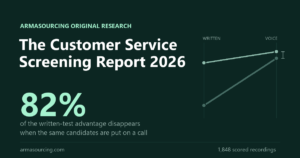
Should you build your contact center in-house or outsource it? It is one of the highest-stakes operational decisions a growing company makes, and the honest answer depends on your volume, growth trajectory, and how central support is to your product. This guide compares the two models on cost, speed, quality, control, and risk, then shows you the hybrid approach most scaling teams actually land on. Whichever way you go, the screening burden does not disappear. Our Customer Service Screening Report sets out what a written assessment does and does not measure.
For the outsourced side of that comparison, our customer service outsourcing cost breakdown shows what providers actually charge and why.
The case for in-house
An in-house desk gives you direct control, agents steeped in your culture and product, and zero coordination overhead with an external vendor. It makes the most sense when:
- Support is a core differentiator and brand experience, not a cost centre.
- Volume is low, stable, and predictable.
- The work is highly specialised, with long ramp times and deep domain knowledge.
- You have regulatory or contractual reasons to keep work onshore and direct.
The trade-off is cost and scalability. You own every hiring decision, training programme, attrition replacement, and coverage gap, and those costs grow linearly with volume.
The case for outsourcing
A managed outsourced contact center hands you a trained, supervised team without the build. The provider recruits, trains, equips, runs QA, and manages day to day, and you pay one predictable per-seat rate. Outsourcing shines when you need to:
- Scale support quickly without a long hiring cycle.
- Cover evenings, weekends, and 24/7 without paying onshore overtime.
- Absorb seasonal or launch-driven spikes.
- Reduce cost meaningfully without sacrificing quality.
Cost reduction, scale, and access to talent are consistently the top reasons organisations outsource business functions, according to Deloitte’s long-running research (Deloitte Global Outsourcing Survey).
Head to head
| Factor | In-House | Managed Outsourced |
|---|---|---|
| Cost per agent / month | $3,500 to $5,500 (fully loaded) | $1,000 to $1,800 (offshore, managed) |
| Time to launch | 2 to 4 months | 2 to 4 weeks |
| Recruiting & attrition | Your problem | Handled by the provider |
| After-hours / 24-7 | Costly overtime | Built in, affordable |
| Scalability | Slow, linear | Fast, elastic |
| Control & culture | Highest | High with a good managed partner |
| Quality visibility | Direct | Via QA and reporting (if managed well) |
For the cost detail behind these numbers, see our call center outsourcing cost guide.
The myth that outsourcing means worse quality
Most horror stories come from unmanaged outsourcing: shared agents juggling several clients, no QA, no dedicated Team Lead, and no reporting. That is not what good outsourcing looks like. A managed model fixes every one of those failure points:
- A dedicated team that works only your account and learns your product.
- Agents working inside your own tools, CRM, and scripts, not a black box.
- Daily QA and call monitoring with scoring against your standards.
- Transparent reporting on AHT, FCR, and CSAT so quality is visible, not a leap of faith.
- A dedicated Team Lead owning coverage, coaching, and adherence.
A decision framework
Ask yourself three questions:
- Is support a core differentiator or a scaling cost? Differentiator leans in-house; scaling cost leans outsourced.
- How fast and how variable is your volume? Fast growth or sharp spikes favour the elasticity of outsourcing.
- What is your true in-house cost? Build the fully-loaded number, not the salary, before you compare.
The hybrid that works
Most scaling teams do not choose one or the other. They keep a small in-house core for complex, brand-critical, or escalated cases and outsource the high-volume tiers: inbound service, outbound follow-up, chat, and ticketing. You keep control where it matters and gain scale, coverage, and cost savings everywhere else.
A worked example: a 15-agent support desk
Imagine you need 15 full-time support agents. Built in-house in the US, fully loaded (salary, benefits, payroll taxes, software, workstations, recruiting, and management overhead), each seat can run $4,000 to $5,000 per month, so the desk costs roughly $60,000 to $75,000 monthly before you account for attrition and the ramp time of every replacement hire. A managed offshore team of the same size typically lands far lower per seat, with recruiting, training, QA, equipment, and a Team Lead already included. The gap is not marginal; it is the difference between a cost centre you ration and a support operation you can actually scale.
The point is not that cheaper is always better. It is that the fully-loaded comparison, not salary versus salary, is the only honest way to evaluate the decision. For the underlying numbers, see our cost guide.
Common objections to outsourcing, answered
- “Our product is too complex.” Complexity raises ramp time, not feasibility. A managed team trained on your runbooks handles complex products every day; you simply invest more in onboarding and Tier-2 technical support.
- “Customers will notice.” With neutral-accented agents working your scripts and tools, what customers notice is faster answers and higher resolution, not a handoff.
- “We will lose institutional knowledge.” A good partner documents your workflows, which often leaves you with better-documented processes than an informal in-house desk.
- “It is risky to hand over data.” A managed provider uses NDAs, least-privilege access, and secured workstations. See our compliance guide.
When to keep it in-house
Outsourcing is not always the answer. Keep support in-house when any of these are strongly true: support is a core, defining part of your brand experience; volume is low, stable, and easily covered by one or two people; the work demands deep, proprietary expertise with very long ramp times; or you have contractual or regulatory reasons that require direct, onshore handling. In these cases the control and culture fit of an in-house desk outweigh the cost and scalability advantages of outsourcing.
How to transition to outsourced (or build a hybrid)
If you decide to outsource, treat it as a managed migration, not a switch you flip:
- Document everything. Capture your scripts, macros, escalation paths, and edge cases. This both speeds onboarding and improves your own processes.
- Start with a defined scope. Hand over one queue or tier first, for example Tier-1 inbound or an email backlog, with clear metrics.
- Run a pilot and review. Give the team 30 to 60 days, then review first-response time, FCR, and CSAT against targets.
- Scale what works. Expand seats and channels once quality is proven, keeping a small in-house core for complex or escalated cases.
This staged approach de-risks the move and usually lands you in a hybrid that combines in-house control with outsourced scale and cost. For the numbers behind the decision, see our cost guide.
Real-world signs it is time to outsource
The decision is usually made by symptoms, not strategy decks. The clearest signals that you have outgrown a purely in-house desk include: response times slipping as volume grows; your best people spending their days on Tier-1 tickets instead of complex or revenue-generating work; an inability to cover evenings, weekends, or holidays without burning out the team; seasonal spikes that you either overstaff for year-round or fail to cover; and an attrition cycle where you are perpetually recruiting and re-training. If two or three of these are true, the math has usually already tipped toward a managed team, because each of them carries a hidden cost that an in-house salary comparison ignores.
The opposite is also worth naming. If volume is flat and easily handled, if every interaction genuinely needs deep proprietary knowledge, or if support is the single most important expression of your brand, staying in-house may be the right call for now. The goal is not to outsource on principle; it is to put each tier of work where it runs best.
How to keep culture and quality when you outsource
The fear that outsourcing dilutes your brand voice is legitimate, and entirely manageable. The companies that preserve quality do a few things consistently. They treat the outsourced team as an extension of their own: sharing product updates, customer context, and feedback the same way they would with internal staff. They invest in real onboarding rather than handing over a thin script. They keep a tight feedback loop through the Team Lead, turning customer and QA insights into weekly coaching. And they hold the partner to transparent metrics so quality is measured, not assumed. Done this way, customers experience faster, more consistent service, and the brand voice is protected by design rather than left to chance. For the security side of that trust, see our compliance guide.
Next step
If you are leaning toward outsourcing, explore managed contact center outsourcing from 10 seats, or book a call to model it against your in-house cost.
Frequently asked questions
Is outsourcing always cheaper than in-house?
For most teams at volume, yes, especially offshore, because the provider absorbs recruiting, training, attrition, equipment, and management into one rate. The exception is very low, stable volume where a single in-house hire suffices.
Will we lose control of quality?
Not with a managed partner. Daily QA, shared scripts and tools, a dedicated Team Lead, and transparent reporting keep quality in your line of sight, often more visibly than an informal in-house desk.
Can we start outsourced and bring it in-house later?
Yes. Many companies use outsourcing to launch or scale fast, then internalise selectively once volume and processes stabilise. A good partner documents your workflows so a future transition is smooth.
Whichever side of the build or buy decision you land on, the staffing maths is the same. Our research on the call center attrition rate breaks down what 884 applications for ten seats revealed about who actually makes it through.
Need a VA who already understands your industry?
We don’t place generalists. Our VAs are matched and trained for the specific workflows of your sector.
See industry VAs →