
Contents
SketchUp + V-Ray is the workhorse stack for small-to-mid-size architecture and interior design firms, fast modeling, photorealistic rendering, accessible learning curve. It’s also one of the most outsourceable software combinations on the market, because the talent pool of Filipino specialists trained on this exact stack is enormous. This post covers when SketchUp + V-Ray outsourcing makes sense, the workflow that actually works, and the production output you should expect.
For the broader buyer’s-guide framework, see our how to outsource 3D rendering guide. To get matched with a vetted Filipino specialist on this stack, see our 3D rendering and architectural visualization service.
Why SketchUp + V-Ray Is the Most Outsourceable 3D Stack
Three reasons:
1. Fast modeling cycle. SketchUp Pro is the fastest production modeler for architectural geometry. Concept-to-block-model in 2 to 4 hours for a typical residence. Compared to Revit (BIM-heavy, slower for early concept) or 3ds Max (steeper learning curve, longer setup), SketchUp wins on iteration speed.
2. V-Ray photorealism without the 3ds Max overhead. V-Ray for SketchUp produces photoreal exterior and interior renders without forcing your team into 3ds Max territory. Material setup, lighting, and post-production workflows transfer cleanly. Output quality matches studios using 3ds Max + V-Ray for 90% of typical project types.
3. Massive Filipino talent pool. SketchUp + V-Ray is taught at most architecture and design programs in the Philippines. Recruiting a specialist with 3+ years of production experience on this exact stack takes days, not months.
What SketchUp + V-Ray Outsourcing Should Cost
A dedicated full-time Filipino specialist proficient in SketchUp + V-Ray runs $1,500 to $2,500 per month for 160 hours. That’s $9.40 to $15.60 per hour, all-in.
For comparison: a US/UK/AU 3D artist with the same skill set costs $60,000 to $90,000 per year in salary alone. Per-render freelancer pricing on Upwork or Fiverr ranges $200 to $1,500 per render, with quality variance that’s brutal at the low end.
The hidden math: a dedicated specialist who learns your material libraries, template scenes, and rendering presets gets faster every month. Per-render freelancers reset to zero each project, you’re paying ramp-up time on every job.
The Workflow That Actually Works
Here’s the rhythm we see in firms running successful SketchUp + V-Ray outsourcing:
Setup (Days 1 to 7):
- Shared Google Drive or Dropbox folder with: source SketchUp files, material library (.skm files), brand guidelines, 10 to 20 example renders for style reference, lighting preferences (golden hour vs midday vs night)
- Specialist installs your specific V-Ray version (5.x or 6.x, they need to match) and tests material library
- First test render delivered for sign-off
Daily production (Weeks 2+):
- You drop new modeling work or render briefs into the project folder
- Specialist confirms scope and timeline (typically 24 to 48 hour turn for hero exterior, 36 to 72 hours for complex interior)
- WIP renders shared at 50% complete for early feedback
- Final delivered with .vrimg files for re-rendering and post-production layers
Weekly sync (15 min):
- Review the week’s deliverables together
- Flag style adjustments or new template needs
- Add new materials to the library
Realistic Production Output
A focused full-time SketchUp + V-Ray specialist produces:
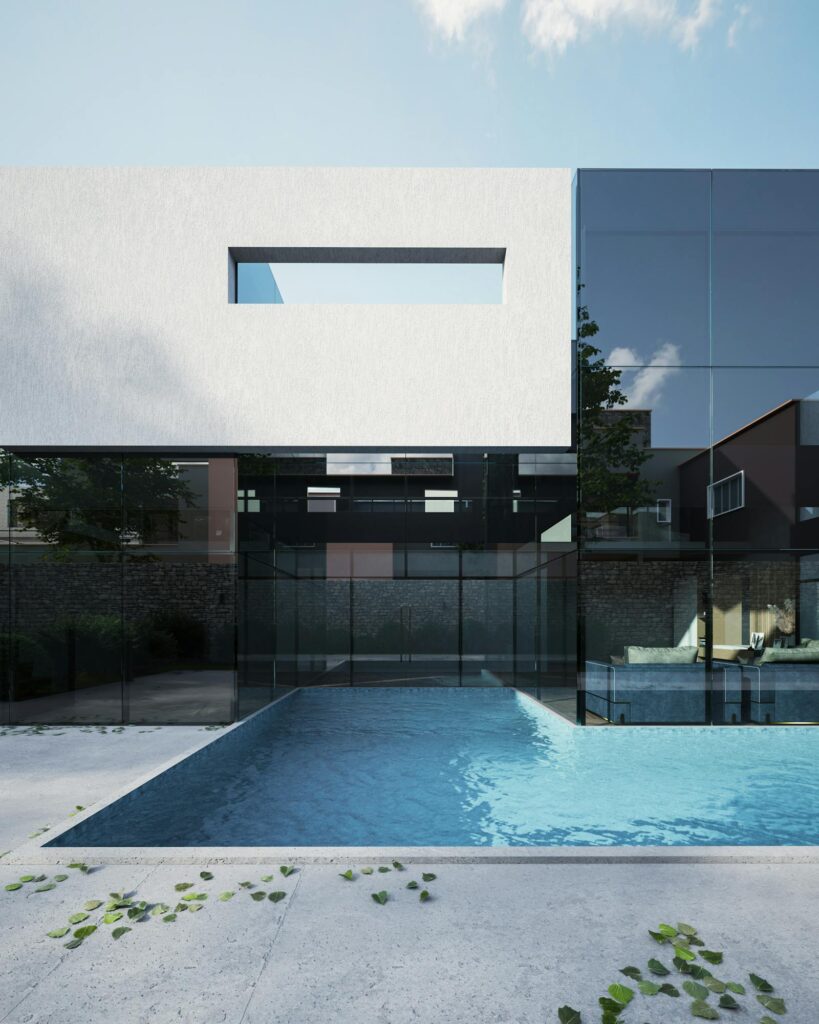
- 8 to 15 photorealistic still renders per week for hero exterior or interior shots (V-Ray production-quality with multi-pass lighting)
- 15 to 25 white-model or massing renders per week for concept presentations
- 3 to 5 SketchUp model builds per week from CAD/PDF source (residential scale)
- 1 walkthrough animation per 2 to 3 weeks if your firm needs animated content (V-Ray Animation or Lumion handoff)
Output climbs significantly after month 2 as the specialist masters your material library and template scenes.
When SketchUp + V-Ray Is NOT the Right Stack
Three scenarios where you should consider a different software pairing:
1. BIM-driven projects. If your firm runs Revit-first workflows, the SketchUp roundtrip wastes time. Better to outsource a Revit + Enscape or Revit + V-Ray specialist who works inside the BIM model directly.
2. Real-time presentations. If you sell with VR walkthroughs or live client design sessions, the SketchUp + V-Ray stack is too slow. Lumion, Enscape, and Twinmotion are built for real-time output.
3. High-end commercial or hospitality. Some prestige projects (museums, hotels, flagship retail) demand 3ds Max + V-Ray or 3ds Max + Corona. The geometry detail and material complexity exceed what SketchUp handles cleanly.
How to Match the Right Specialist to Your Pipeline
Don’t accept a generic “3D artist” who lists 12 software packages on their CV. The specialist who’s spent 3+ years specifically in SketchUp + V-Ray production will outperform a generalist on every metric: speed, quality, and material instinct.
When evaluating, ask:
- Which V-Ray version are you most current on?
- Show me 5 hero renders from real projects produced in SketchUp + V-Ray (not Lumion, not 3ds Max).
- How do you handle interior lighting setups (HDRI vs V-Ray Sun/Sky vs IES profiles)?
- What’s your typical material library workflow, V-Ray Material Library, Chaos Cosmos, or custom?
- How do you handle vegetation and entourage (Forest Pack alternative for SketchUp)?
Strong answers indicate production experience. Weak or generic answers indicate someone who’s done a few personal projects but hasn’t worked at a firm.
Common Mistakes (and Fixes)
Mistake 1: Sending PDFs instead of SketchUp files. If you’re outsourcing to a specialist on this stack, give them the .skp source. PDF-to-render workflows add 50% time per project for no quality gain.
Mistake 2: No material library handoff. Your local studio has spent years building a custom V-Ray material library. Hand it over on day one. The specialist who has to rebuild every wood grain, every fabric, every concrete texture from scratch will be slower for months.
Mistake 3: Vague lighting briefs. “Make it look nice” wastes everyone’s time. Specify time of day, weather, mood, sun position, and 3 reference images. Specialist quality compounds with brief specificity.
Mistake 4: Skipping V-Ray version alignment. V-Ray 5 and V-Ray 6 produce different materials and lighting results. If your team is on 6.x and the specialist is on 5.x, expect inconsistent output. Align on day one.
Getting Started
If SketchUp + V-Ray is your firm’s stack and you want a vetted Filipino specialist on production this week, our 3D rendering service screens specifically for SketchUp + V-Ray production experience. Most firms are matched with a candidate within 5 to 7 days, with a 48-hour test render to validate fit before you commit.
Already use this tool? Hire someone who already knows it.
Don’t spend 3 months training a generalist. Our Filipino VAs already work in the platforms you read about.
Find a specialist →