Contents
Two specialist medical practices in Sydney had the problem every small practice knows. The phone rings while the doctor is with a patient and the front desk is busy, and a missed call is often a patient who books somewhere else. They wanted one dedicated receptionist covering both lines in Sydney business hours, who knows each practice’s fees, rules and doctors, and never mixes them up.
Since September 2026 Armasourcing has run that desk from Manila. This page explains how it works. We do not name the practices: they handle patient calls, and their patients’ privacy comes first.
Here is the desk in three and a half minutes, before, during and after a call:
The client at a glance
- Client: two independent specialist medical practices in Sydney, Australia
- Service: one dedicated receptionist, based in Manila, answering both practices’ phone lines during Sydney business hours
- Agreement signed: 10 September 2026
- Receptionist’s first day: 23 September 2026
- System: the Arma Reception Desk, our in-house reception system, with its assistant features running on Claude by Anthropic
What the practices needed
The service agreement set the bar in writing:
- Calls answered live during working hours, with each practice’s own greeting
- Every missed call returned within 30 minutes
- Urgent messages for a doctor relayed within 15 minutes
- Voicemails delivered to the practice by email
- No double bookings, and patient details kept out of any system that does not need them
Two practices on one desk adds a harder requirement. The receptionist has to know which practice a caller rang before she says hello, because the two have different fees, different appointment types and different rules about what must never be said on the phone.
How the Arma Reception Desk works
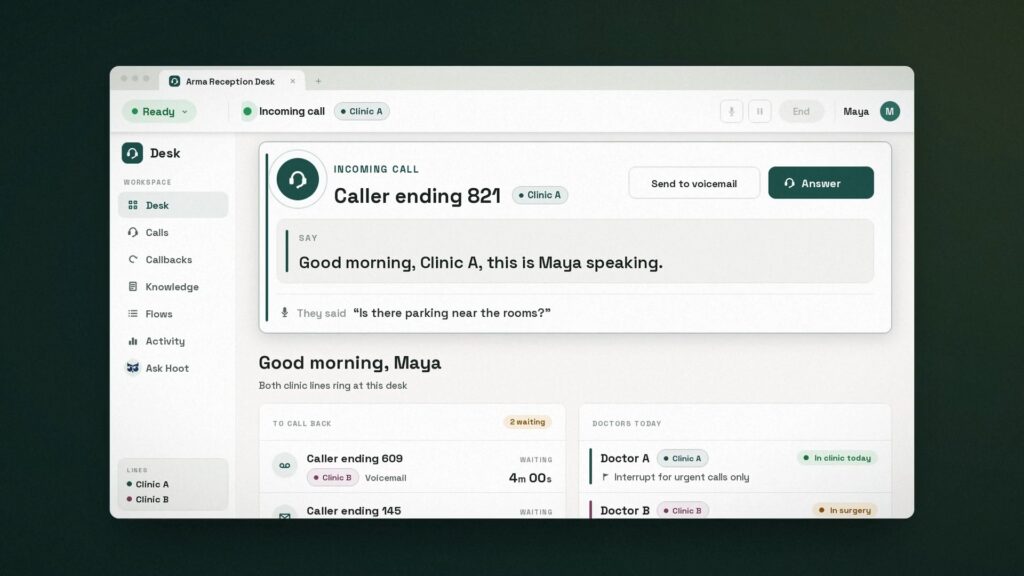
She knows which practice the caller rang before she answers
Both Sydney numbers ring the same desk. The call card names the practice the caller dialled, so she opens with the right greeting every time. Callers can also say in a few words why they are calling before the phone rings, and that reason appears on the card when it does.
Each practice’s rules are one click away
The desk holds a knowledge base for each practice, written from the doctors’ own call flowcharts and phone FAQs: locations, hours, appointment types, fees, and a plain “say this, never say that” list for the phrases each practice wants handled carefully. A fee and procedure finder matches the words patients actually use to the practice’s own terms.
Hoot, the assistant inside the desk, runs on Claude
When the answer is not already on screen, the receptionist asks Hoot. Hoot is built on Claude by Anthropic and answers only from the practices’ own material. It is instructed to refuse clinical advice and to follow the practice’s escalation steps instead, and it never repeats patient details. Before go-live we tested it on exactly those cases: a fee question, the “doctor is not in today” situation, and a post-operative clinical question, which it declined and escalated.
Live help during the call, and a drafted outcome after it
On incoming calls the desk shows a live transcript and suggestion cards, for example the practice’s own name for a procedure the caller describes in everyday words. When the call ends, Claude drafts the call record (what kind of call it was, what happened and a short note) and the receptionist checks it before she saves. Nothing from that live session is stored.
Every recorded call gets a quality review
After a recorded call, Claude reviews it against the practice’s rules, including the never-say list, and flags anything our operations managers should go over with the receptionist. The coaching itself is done by our managers.
Every callback runs on a timer
Every missed call, voicemail and “doctor to call back” message lands on one worklist with a timer. If a callback passes the 30-minute promise, our operations managers are alerted, weekends included. Messages for a doctor are tracked from the moment they come in until the doctor replies. When the receptionist is on a break, callers hear a short message and can leave a voicemail instead of ringing out.
Patient privacy by design
- The call log keeps only the last three digits of a caller’s number and the outcome, never a name.
- Patient details go into the practices’ own booking systems, not into the desk.
- The receptionist’s call notes stay in her browser and clear themselves after seven days.
- Incoming calls are recorded only after the caller hears a notice, and recordings are deleted after 30 days.
- Three people can sign in to the desk: the receptionist and two Armasourcing managers.
How we measure it
We track the desk every day against the measures in the agreement: the live answer rate during working hours, callbacks within 30 minutes, doctor relays within 15 minutes, and a written end-of-day digest for our operations team. When a measure slips, we see it the same day and look for the cause.
What this means for your practice
If your practice is losing calls, one dedicated receptionist with the right tools can be enough. She works your hours, learns your rules, and every call she misses is tracked until someone calls the patient back. We can set up the same kind of desk for your practice, whether you run one line or several.
See how our virtual receptionist and answering service works, or book a call and tell us how your phones run today.
Get matched with a vetted Filipino VA in 7 days
Pre-vetted, US-trained Filipino virtual assistants. Fully managed. EST/PST timezone overlap. Custom pricing, zero placement fees.
Book a free discovery call →