Contents
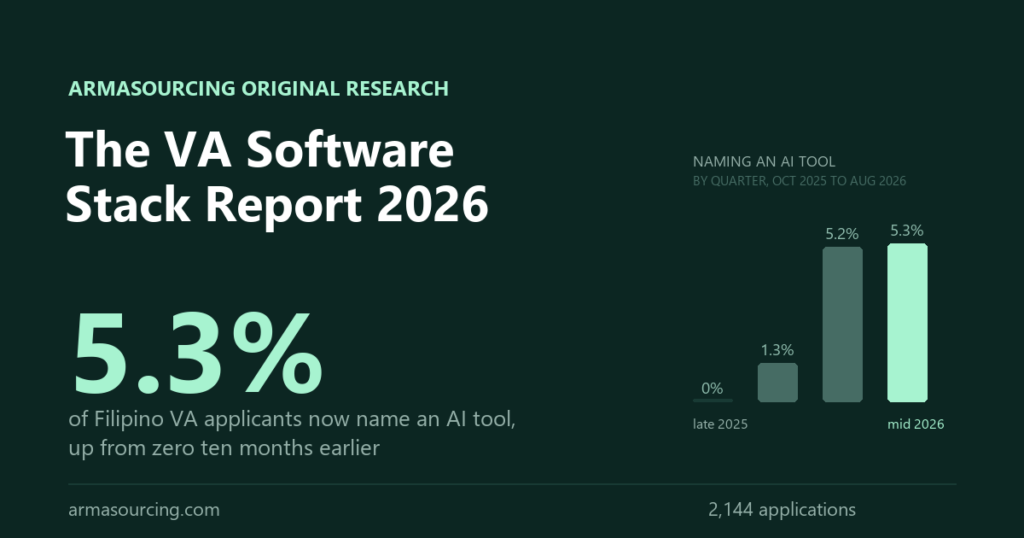
Filipino virtual assistant applicants now name ChatGPT more often than QuickBooks or Salesforce, and almost none of them did ten months ago. That is the headline finding from 2,144 real job applications submitted to Armasourcing between October 2025 and August 2026, scanned for 137 named software products. This report shows which tools Filipino VAs actually bring up when describing their own work, which stacks travel together, and why 61.6 percent of applications name no software at all.
Key Takeaways
- AI arrived in ten months. Mentions of an AI or automation tool went from 0 percent of applications in late 2025 to 5.3 percent by mid 2026 (1.1 percent to 5.3 percent between halves, z = 4.47, p < 0.001).
- ChatGPT is now the eighth most named tool overall at 71 applications, ahead of QuickBooks (66) and Salesforce (65).
- 61.6 percent of applicants name no software at all when describing their experience. The median application names zero tools.
- Bookkeepers are the exception. 41.2 percent of bookkeeping applicants name QuickBooks and 30.0 percent name Xero, the highest tool literacy of any role family.
- The roles hyped for AI are the ones not using it. Sales and appointment setting sits at 0.0 percent AI mentions, while web and technical roles lead at 16.3 percent.
- QuickBooks and Xero are complements, not rivals. 40.9 percent of applicants who name QuickBooks also name Xero.
Quick answer: The most commonly named tools in Filipino VA applications are Google Workspace (9.5%), Canva (8.1%), Microsoft Office (5.8%) and Microsoft Excel (4.7%). Specialist software concentrates by role: QuickBooks and Xero for bookkeeping, Canva and Meta Business Suite for social media, WordPress and Elementor for web work. These are unprompted mentions, so treat every figure as a floor rather than a proficiency rate.
Where this data comes from
Every number here is first-party data: 2,148 unique applications submitted directly to Armasourcing, a Philippine virtual assistant agency, between October 2025 and August 2026. 2,144 of them contained enough written experience to scan. We searched each application’s own writing, meaning the job title, the description of past responsibilities, the pitch for why they are a good fit, and any additional notes, for 137 named software products across 15 categories.
The single most important caveat, stated up front. Our application form never asks candidates to list their software. Every mention in this report is unprompted: the applicant chose to bring the tool up while describing their work. That makes each figure a floor, not a proficiency rate. When we report that 8.1 percent of applicants named Canva, that is not a claim that only 8.1 percent can use Canva. It is a claim about what Filipino VAs volunteer when nobody prompts them, which is exactly what a hiring manager reads. The useful comparisons in this report are relative ones: which tools get volunteered over others, which roles name tools at all, and how that changes over time.
Finding 1: AI showed up in ten months
The clearest movement in the data is the arrival of AI tools. In applications submitted from October to December 2025, not one applicant named an AI tool. By April 2026 the rate had jumped and it has held there since.
Share of applications by quarter of submission
Comparing the first half of the window (October 2025 to March 2026) with the second (April to August 2026), AI mentions rise from 1.1 percent to 5.3 percent (z = 4.47, p < 0.001) and ChatGPT specifically from 0.2 percent to 4.7 percent (z = 5.31, p < 0.001). The break is sharp and lands in April 2026 rather than drifting upward, which is what adoption of a tool that suddenly becomes normal to admit looks like.
| Quarter | Applications | Name an AI tool | Name ChatGPT |
|---|---|---|---|
| Oct to Dec 2025 | 87 | 0 (0.0%) | 0.0% |
| Jan to Mar 2026 | 549 | 7 (1.3%) | 0.2% |
| Apr to Jun 2026 | 560 | 29 (5.2%) | 4.3% |
| Jul to Aug 2026 | 943 | 50 (5.3%) | 4.9% |
The composition matters as much as the trend. ChatGPT accounts for most of it, but the automation platforms underneath are the more interesting signal for employers.
| AI or automation tool | Applications | Share of all 2,144 |
|---|---|---|
| ChatGPT | 71 | 3.3% |
| n8n | 19 | 0.9% |
| Zapier | 11 | 0.5% |
| Claude | 3 | 0.1% |
| Microsoft Copilot | 2 | 0.1% |
| ElevenLabs | 2 | 0.1% |
| Make (Integromat) | 2 | 0.1% |
| Google Gemini | 1 | 0.0% |
| Perplexity | 1 | 0.0% |
n8n at 19 mentions is the surprise. It is a developer-leaning workflow automation tool, and it appears more often than Zapier (11), which is the tool most people would expect a virtual assistant to name. Read alongside our AI Visibility Index, which tracks how AI assistants recommend outsourcing firms, the picture is of a workforce adopting AI faster than the industry that hires it.
Finding 2: most applicants name no software at all
1,321 of 2,144 applicants (61.6 percent) never name a single software product while describing their own work. The median application names zero tools; the mean is 1.0.
Named software products per application, base 2,144 applications
This is not evidence that 61.6 percent of Filipino VAs cannot use software. It is evidence that they write about duties rather than systems. An application will say “handled customer inquiries and managed the calendar” where it could say “handled customer inquiries in Zendesk and managed the calendar in Calendly.” The small group who do name tools name a lot of them: 69 applicants name six or more.
For anyone hiring, that has a direct consequence. Screening on tool keywords will reject most of the market, including people who use those tools daily. If your job posting filters on software names, you are not filtering for skill so much as for the habit of writing about software. Our Customer Service Screening Report found a related effect: unproctored written tests rank candidates by tool access rather than ability.
The leaderboard: what Filipino VAs actually name
Share of all 2,144 applications, unprompted mentions
The top of the table is generic and the middle is where the market shows itself. Google Workspace (203 applications) and the Microsoft stack are table stakes. Canva at 173 applications is the first genuinely discretionary tool, and it outranks every CRM, every accounting package and every helpdesk in the data. The design tool a business would consider a nice-to-have is the one Filipino VAs name most.
| Rank | Tool | Category | Applications naming it | Share of all 2,144 | Share of the 823 who named any |
|---|---|---|---|---|---|
| 1 | Google Workspace | Office and data | 203 | 9.5% | 24.7% |
| 2 | Canva | Design and video | 173 | 8.1% | 21.0% |
| 3 | Microsoft Office | Office and data | 124 | 5.8% | 15.1% |
| 4 | Microsoft Excel | Office and data | 100 | 4.7% | 12.2% |
| 5 | GoHighLevel | CRM and sales | 91 | 4.2% | 11.1% |
| 6 | Shopify | Ecommerce | 72 | 3.4% | 8.7% |
| 7 | HubSpot | CRM and sales | 71 | 3.3% | 8.6% |
| 8 | ChatGPT | AI and automation | 71 | 3.3% | 8.6% |
| 9 | QuickBooks | Accounting | 66 | 3.1% | 8.0% |
| 10 | Salesforce | CRM and sales | 65 | 3.0% | 7.9% |
| 11 | WordPress | Web and CMS | 61 | 2.8% | 7.4% |
| 12 | Slack | Communication | 59 | 2.8% | 7.2% |
| 13 | Google Sheets | Office and data | 50 | 2.3% | 6.1% |
| 14 | Zendesk | Customer support | 42 | 2.0% | 5.1% |
| 15 | Xero | Accounting | 40 | 1.9% | 4.9% |
| 16 | Zoom | Communication | 39 | 1.8% | 4.7% |
| 17 | Notion | Project management | 38 | 1.8% | 4.6% |
| 18 | CapCut | Design and video | 37 | 1.7% | 4.5% |
| 19 | Asana | Project management | 29 | 1.4% | 3.5% |
| 20 | Trello | Project management | 28 | 1.3% | 3.4% |
| 21 | Meta Business Suite | Marketing and social | 27 | 1.3% | 3.3% |
| 22 | Gorgias | Customer support | 25 | 1.2% | 3.0% |
| 23 | Adobe Photoshop | Design and video | 25 | 1.2% | 3.0% |
| 24 | LiveChat | Customer support | 23 | 1.1% | 2.8% |
| 25 | ClickUp | Project management | 22 | 1.0% | 2.7% |
| 26 | Calendly | Scheduling and field ops | 20 | 0.9% | 2.4% |
| 27 | Monday.com | CRM and sales | 20 | 0.9% | 2.4% |
| 28 | Elementor | Web and CMS | 20 | 0.9% | 2.4% |
| 29 | n8n | AI and automation | 19 | 0.9% | 2.3% |
| 30 | SAP | Accounting | 18 | 0.8% | 2.2% |
Category by category
CRM: GoHighLevel leads, and it is an agency story
GoHighLevel (91) edges HubSpot (71) and Salesforce (65). GoHighLevel is a marketing-agency platform rather than a general CRM, and its appearance at the top reflects how much Filipino VA work runs through small US marketing agencies.
| CRM and sales platform | Applications | Share of all 2,144 |
|---|---|---|
| GoHighLevel | 91 | 4.2% |
| HubSpot | 71 | 3.3% |
| Salesforce | 65 | 3.0% |
| Zoho | 12 | 0.6% |
| Pipedrive | 2 | 0.1% |
| Keap | 1 | 0.0% |
Accounting: QuickBooks leads, Xero rides along
QuickBooks (66) outranks Xero (40), but the more useful number is the overlap: 40.9 percent of applicants who name QuickBooks also name Xero. Filipino bookkeepers are not split into two camps. They learn both, because their clients are split.
| Accounting platform | Applications | Share of all 2,144 |
|---|---|---|
| QuickBooks | 66 | 3.1% |
| Xero | 40 | 1.9% |
| SAP | 18 | 0.8% |
| MYOB | 4 | 0.2% |
| FreshBooks | 1 | 0.0% |
| NetSuite | 5 | 0.2% |
| Wave Accounting | 1 | 0.0% |
Design, support and project management
| Design and video tool | Applications | Share of all 2,144 |
|---|---|---|
| Canva | 173 | 8.1% |
| Adobe Photoshop | 25 | 1.2% |
| CapCut | 37 | 1.7% |
| Adobe Premiere Pro | 9 | 0.4% |
| Figma | 7 | 0.3% |
| Adobe Illustrator | 3 | 0.1% |
| Helpdesk platform | Applications | Share of all 2,144 |
|---|---|---|
| Zendesk | 42 | 2.0% |
| Freshdesk | 7 | 0.3% |
| Intercom | 4 | 0.2% |
| Gorgias | 25 | 1.2% |
| LiveChat | 23 | 1.1% |
| Project management tool | Applications | Share of all 2,144 |
|---|---|---|
| Notion | 38 | 1.8% |
| Asana | 29 | 1.4% |
| Trello | 28 | 1.3% |
| ClickUp | 22 | 1.0% |
| Airtable | 8 | 0.4% |
| Jira | 4 | 0.2% |
| Monday.com | 20 | 0.9% |
Tool literacy varies enormously by role
Aggregate figures hide the real pattern. Some role families name tools constantly and others almost never.
| Role family | Applications | Most named tools within the family | Name an AI tool |
|---|---|---|---|
| Customer service and support | 616 | Shopify 7.0%, Google Workspace 6.5%, Salesforce 6.3%, Zendesk 5.2% | 2.1% |
| Executive and admin | 532 | Google Workspace 18.8%, Canva 11.7%, Microsoft Office 9.0%, GoHighLevel 7.1% | 6.4% |
| Sales and appointment setting | 114 | HubSpot 6.1%, Canva 5.3%, Salesforce 4.4%, Google Workspace 4.4% | 0.0% |
| Social media and content | 114 | Canva 33.3%, Meta Business Suite 14.0%, CapCut 9.6%, Google Workspace 5.3% | 4.4% |
| Bookkeeping and finance | 80 | QuickBooks 41.2%, Xero 30.0%, Microsoft Excel 18.8%, Microsoft Office 6.2% | 0.0% |
| Marketing and SEO | 77 | Google Search Console 15.6%, Canva 15.6%, WordPress 14.3%, Google Analytics 14.3% | 5.2% |
| Healthcare and medical | 70 | Google Workspace 8.6%, Microsoft Office 5.7%, Microsoft Excel 4.3%, Kareo 2.9% | 1.4% |
| Creative and video | 51 | Canva 13.7%, CapCut 9.8%, Adobe Premiere Pro 7.8%, WordPress 5.9% | 0.0% |
| Web and technical | 49 | WordPress 55.1%, Elementor 24.5%, GoHighLevel 18.4%, Shopify 10.2% | 16.3% |
| Real estate and property | 38 | Canva 10.5%, Notion 10.5%, AppFolio 7.9%, Zendesk 7.9% | 2.6% |
Three things stand out:
- Bookkeeping is the most tool-literate role family in the data. 41.2 percent name QuickBooks and 30.0 percent name Xero, against an overall rate where the leading tool reaches 9.5 percent. Bookkeepers describe their work in systems because the system is the work.
- Social media applicants are a Canva monoculture. 33.3 percent name Canva, 14.0 percent name Meta Business Suite. If you are hiring a social media VA, Canva fluency is not a differentiator.
- Customer service, the largest family at 616 applications, names almost nothing. Its top tool reaches only 7.0 percent. The biggest slice of the VA market is also the least likely to describe itself in software.
Role families with at least 30 applications
The AI split is the counterintuitive one. Web and technical applicants name AI tools at 16.3 percent, while sales and appointment setting, bookkeeping and creative roles sit at zero. Sales is the function with the loudest AI tooling market, and not one of the 114 sales applicants in this window mentioned an AI tool. Adoption is running along technical lines, not along the lines the software industry is selling to.
Stacks that travel together
Tools cluster. Knowing one name predicts the others, which is useful when you are writing a job description or judging whether a candidate has really run the workflow.
| When an applicant names | Base | They also name |
|---|---|---|
| Microsoft Excel | 100 | Google Workspace 38.0%, Microsoft Office 22.0%, Google Sheets 20.0%, QuickBooks 15.0%, Xero 11.0% |
| Canva | 173 | Google Workspace 38.2%, CapCut 20.2%, Microsoft Office 19.7%, ChatGPT 15.0%, Meta Business Suite 11.6% |
| GoHighLevel | 91 | Canva 16.5%, Google Workspace 14.3%, HubSpot 13.2%, WordPress 9.9%, Microsoft Office 9.9% |
| QuickBooks | 66 | Xero 40.9%, Microsoft Excel 22.7%, Google Workspace 13.6%, HubSpot 9.1%, Microsoft Office 9.1% |
| Shopify | 72 | Gorgias 25.0%, Google Workspace 19.4%, Zendesk 19.4%, Amazon Seller Central 18.1%, Canva 15.3% |
The ecommerce signature is the tightest: 25.0 percent of applicants who name Shopify also name Gorgias, a helpdesk that is almost exclusively used by Shopify merchants. An applicant who names both has very likely worked a real ecommerce support desk. For role-by-role hiring benchmarks, our Filipino VA Salary Report covers what each of these role families asks to be paid, and the Philippine VA Talent Map covers where they are.
What this means if you are hiring
- Do not screen on tool keywords. 61.6 percent of applicants name no software, and that group contains competent people who simply write about duties. Ask about tools in the interview instead of filtering on them in the application.
- Ask for the stack, not the tool. Anyone can claim Shopify. Ask which helpdesk sat next to it. The clusters in this report are hard to fake because they reflect real workflows.
- Expect to train on your CRM, not on the basics. Google Workspace and Office are near-universal. The specific CRM almost never matches: even the leading platform appears in 4.2 percent of applications.
- Bookkeeping is the one role where you can screen on software, because that market genuinely speaks in QuickBooks and Xero.
- AI fluency is still rare and worth paying attention to. At 4.0 percent overall it remains a differentiator rather than a baseline, and it is concentrated in technical roles.
If you want to model the cost side of these roles, our virtual assistant cost calculator uses the salary data behind this same applicant pool, and the full set of free hiring tools lives on our tools page.
Methodology
Source. 2,148 applications submitted to Armasourcing between October 2025 and August 2026. 2,144 carried enough written experience to scan, which is the denominator for every figure unless a table names its own base.
Matching. Each application’s own writing was searched for 137 products across 15 categories using word-boundary patterns, counted once per application. Product names that collide with ordinary English were either required in a disambiguated form or dropped entirely. Under-counting is the safe error for research like this; over-counting is not.
- Word: kept only as “MS Word” or “Microsoft Word”.
- Make: the automation platform collides with the verb; kept only as “Make.com” or “Integromat”.
- Close: the CRM collides with the verb; dropped entirely.
- Front: the shared inbox collides with the noun; dropped entirely.
- Wave: kept only as “Wave Accounting” or “Wave apps”.
- Monday: kept only as “Monday.com”; the weekday is far more common.
- Later: kept only as “Later.com” or “Later app”.
- Teams: kept only as “Microsoft Teams” or “MS Teams”.
- Epic: kept only as “Epic EMR” or “EpicCare”; the adjective is common.
- Jasper: kept only as “Jasper AI”; it is also a personal name.
- Claude: kept only as “Claude AI” or “Anthropic”; it is also a personal name.
- Gemini: kept only as “Google Gemini” or “Gemini AI”; it is also a star sign and a personal name.
- Notion: excluded where followed by “of” or “that”.
- Excel: excluded where used as the verb, as in “excel at” or “excel in”.
What we threw away, and why you should care. Our applicant database carries a machine-extracted skills field for each candidate, generated automatically when the application syncs. It would have tripled our sample. We excluded it entirely, because checking it against the applicants’ own writing showed it was contaminated with job-posting boilerplate rather than candidate claims.
The clearest case: the extracted field named GoHighLevel in 462 applications where the applicant never wrote it anywhere, including medical and social media roles where the tool has no place. Only 16.5 percent of its appearances were corroborated by the candidate’s own words. Had we counted that field, GoHighLevel would have appeared in 25.7 percent of applications and led this report as the most named tool in the Philippine VA market. That would have been wrong, and the error would have flattered a headline. Every figure in this report comes from what applicants themselves wrote.
Limits. This is one agency’s applicant flow, so the role mix reflects what our clients hire for rather than the Philippine VA market as a whole. Mentions are self-reported and unverified: naming a tool is not proof of competence with it. Because mentions are unprompted, absolute rates understate real familiarity and should be read as floors. Role families are assigned from the position applied for, and families below 30 applications are not reported. Applications from before October 2025 predate the current form and are excluded.
Citing this report
You are welcome to cite any statistic, chart or table here with attribution and a link to this page.
Suggested citation: “Armasourcing VA Software Stack Report 2026, based on 2,144 Filipino virtual assistant applications received October 2025 to August 2026.”
For press enquiries, the underlying aggregate tables, or a breakdown for a specific tool or role family, get in touch here. We are happy to run a cut for a specific software vendor on request.
Frequently asked questions
What software do Filipino virtual assistants use?
Across 2,144 applications, the most commonly named tools are Google Workspace (9.5 percent), Canva (8.1 percent), Microsoft Office (5.8 percent) and Microsoft Excel (4.7 percent). Specialist tools concentrate by role: QuickBooks and Xero in bookkeeping, Canva and Meta Business Suite in social media, WordPress and Elementor in web work, Zendesk and Gorgias in customer support.
Do Filipino VAs use AI tools like ChatGPT?
A growing minority do. 4.0 percent of applications name an AI or automation tool, with ChatGPT the most common at 71 mentions. The rate rose from zero in late 2025 to 5.3 percent by mid 2026. Adoption is concentrated in web and technical roles at 16.3 percent, and is at zero in sales, bookkeeping and creative roles.
Which CRM do Filipino virtual assistants know best?
GoHighLevel is named most often, in 91 applications, ahead of HubSpot at 71 and Salesforce at 65. GoHighLevel is an agency platform, and its lead reflects how much Filipino VA work runs through small US marketing agencies rather than corporate sales teams.
Should I screen VA applicants by the software they list?
Generally no. 61.6 percent of applicants name no software at all when describing their experience, because most write about duties rather than systems. Filtering on tool keywords rejects a large share of capable candidates. Bookkeeping is the exception, where 41.2 percent name QuickBooks and screening on software is meaningful.
How was this data collected?
From 2,148 real job applications submitted directly to Armasourcing between October 2025 and August 2026, of which 2,144 carried enough written experience to scan. Each application’s own writing was searched for 137 named software products. A machine-extracted skills field was available but excluded after it proved contaminated with job-posting boilerplate. Nothing was surveyed and nothing was scraped.
Need a VA who already understands your industry?
We don’t place generalists. Our VAs are matched and trained for the specific workflows of your sector.
See industry VAs →